



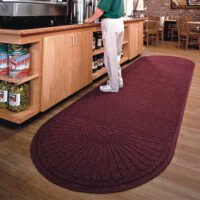
Thorough planning, the right equipment and a consistent plan make for longer-lasting, better-looking carpets and mats.
Proper Planning
Choosing the Right Cleaning Equipment
Establishing a Maintenance Plan
Mat Cleaning Guidelines
Proper Planning
The first step in reducing soil and moisture being tracked into a building is to prevent as much of it as possible from entering in the first place. This begins outside, with keeping walkways and parking lots clean. In winter, removing snow and ice from walkways helps prevent moisture from entering buildings. For added convenience and reduced maintenance costs try our Portable Melt-Away Snow and Ice Melting Mat.
Many people assume purchasing one mat and placing it in their building is adequate. The assumption is that all mats are the same. This is a general and common misconception. In fact, every mat we offer is designed with certain qualities and functionality intended for a specific application. Selecting the proper matting system incorporates three stages.
The first stage is to invest into a good quality outdoor scraper mat. Scraper mats, like our MultiGuard Finger Mat, are aggressive mats designed to remove large pieces of soil, snow and ice from shoes. These mats should be placed at all entrances into a building.
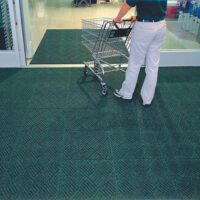
The second stage involves placing a second mat directly inside the door extending 4-8 feet to capture any remaining large soil particles, as well as dust and moisture, from shoes. It is a good idea to use a mat with a rubber water-dam design. This design, constructed with barrier ridges on the edges, keeps moisture on the mat. Our rubber-backed Sponge Mat is ideal for this application. It has the ability to hold 1-1/2 gallons of water per square yard of carpet.
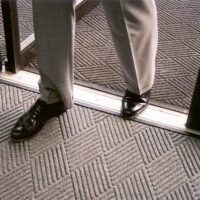
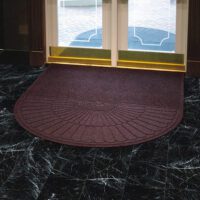
The third stage is a walk-off mat with dense fibers capable of capturing any fine dust or soil residue still on shoes. The mat selected should also be based on the amount of traffic that enters your building. We offer several high quality mats designed to meet this criteria. Review our Entrance Mat section for a wide selection of Rubber Backed or Vinyl Backed mats. Refer to our Frequently Asked Questions for a review on selecting rubber vs. vinyl. These should be placed in the main lobby or foyer area of a building. The size of this mat depends on the area to cover. For a lasting impression consider adding your company’s corporate message with a Company Logo Mat. These mats should be cleaned frequently to maintain an attractive appearance to visitors and because dirty mats loaded with soil are not as effective in decreasing the amount of soil tracked into buildings. But maintaining a good image isn’t the only reason to keep floors clean and aesthetically pleasing. Cleaning carpets promotes a healthier indoor environment and better working conditions. Removing dust, mold, allergens, and bacteria-laden particulates is just one way a cleaner carpet contributes to a healthier facility. Regular cleaning also extends the life an wearability of the carpet and allows managers to use financial savings in their budget elsewhere.
Choosing the Right Cleaning Equipment
Carpet cleaning machines can be expensive. Large carpeted areas might require such equipment as walk-behind extractors, shampoo machines, wide-area vacuums, and other more expensive machines. While these big-ticket items are an important part of a carpet maintenance program, other equally important facets of carpet care make up a systematic maintenance program. A good all-around carpet maintenance system also incorporates smaller pieces of equipment that help remove soiling and spots that occur inside all areas of a building.
A vital element of any carpet-care program is a spotting kit. These kits come with cleaning chemicals designed to remove specific soils and stains, a spotting chart, and a general spotting agent. Cleaning crews can follow the spotting chart for directions on which chemical to use if a general spotter doesn’t remove a spot or soiled area. Spotting kits usually contain chewing-gum-removal products, as well as scrapers and brushes that can agitate the fibers.
A portable extractor is a must in removing spills and spots before they become stains. These machines come in a variety of sizes. The smallest are handheld and can be carried easily to extract and rinse a problem as small as a beverage spill. Some smaller extractors have up to three tanks — one for a cleaning solution, a recovery tank for dirty solution, and one for clear rinse water. Larger portable extractors have larger-capacity tanks for cleaning solutions and accessories, such as hoses and wands. These machines can be used for cleaning entrances and eating areas, such as lunchrooms and break rooms.
Water vacuums with wands for use on carpets and rugs are invaluable in situations where cleaning crews must remove large amounts of water from a floor. Water vacuums are designed to remove large amounts of water quickly and have bigger recovery tank capacities than smaller portable extractors. Generally, water vacuums are not used for cleaning carpets unless they have cleaning solution hose attachments.
Establishing a Maintenance Plan
For best results, mats should receive scheduled cleanings. Our carpet and entrance mats are designed to lower your maintenance costs and still be easily maintained. Simply follow these instructions to keep your mats looking great and functioning effectively. Carpet mats can be cleaned the same way you maintain your carpeting. Vacuum them daily and extract or shampoo them when dirt builds up.
A successful maintenance plan begins with proper daily care. Daily cleaning requires vacuuming. In areas where a wide-area vacuum is not practical, smaller upright vacuums and backpack vacuums are useful. The advantage of smaller, portable vacuums is their ease of use. Backpack vacuums allow users to work in otherwise inaccessible areas, such as stairways and landings. They are also useful in crowded areas, such as offices. Newer-generation backpacks and uprights are designed to have better suction and filtration capacity, and now high-efficiency particulate-arrestance (HEPA) filters are standard in many models.
The mats should be checked at least on a weekly basis for stains and dirt depending on the amount of traffic. To remove some stubborn stains, many departments use a steam-vapor cleaner. These machines inject steam into the carpet, and the cleaner then blots out the stain. These small, portable machines combine high heat and low moisture to clean and disinfect spots and soiled areas on carpet and hard surfaces.
Steam cleaning or shampooing is recommended based on the amount of traffic the mat receives. Once a month is typically a good plan. We recommend purchasing 2 identical mats for your indoor areas. When one mat is being cleaned it can be replaced by the second mat. This is a great way to ensure that your floors are always protected and to extend the life and wearability of both mats.
Having an effective carpet maintenance program takes planning and commitment. The proper equipment and supplies, combined with regular training, will help ensure the carpets look clean and attractive, last longer, and promote a healthier indoor environment.
Specific Mat Surface Cleaning Guidelines
The following recommendations are based on the surface of your mat. We always recommend contacting us directly before using any chemicals or cleaners on your mat that your not sure of.
SpongeCote Mats, PVC Sponges and Urethane Mats (Dry Area Mats)
Sweep regularly or dry-mop the surface. These mats can be wet-mopped with mild soap or detergent. For best results use a detergent like Ivory Liquid with a ph between 4.0-9.0.
Molded Rubber and PVC Anti-Fatigue Mats (those designed for Wet Areas)
Use a high pressure hose (not to exceed 1800 psi) and hot water (max 160 degrees F) to rid the mats of oils. For best results use a mild soap or detergent like Ivory Liquid with a ph between 4.0 – 9.0, to clean the mats. Do not use steam, degreasers or caustic chemicals. Do not machine wash or mechanically scrub the mats.
ESD Mats (Conductive and Non-Conductive)
When cleaning ESD mats, it is important to sweep or dry-mop the surface regularly. Also wet-mop or wipe of with mid soap of a static control cleaning solution that will not leave a residue. This will allow the mat to continue to function effectively.
Runner Mats
Simply sweep the surface with a broom or vacuum (bare floor setting). Our runners can be wet-mopped with a mild soap.
Carpet and Entrance Mats
For scraper mats, shake them outside to remove any loose dirt and debris. If necessary, use a hose (avoid extremely high pressure or high temp) to wash them off. A mild soap can be used for heavy soiled or dirty mats.
Carpeted mats can also be shaken outside, if manageable. Carpeted mats can be cleaned the same way you maintain your regular carpeting. Vacuum them daily and extract or shampoo them when dirt builds up. Stains should be blotted with an approved product for regular carpeting. The most important aspect to maintaining clean carpets is establishing a routine cleaning schedule.
